


Dulse, a type of red seaweed, is rising in popularity today for both its culinary and medicinal purposes.
In this article, we will look at the health benefits of dulse, its safety, and its history.
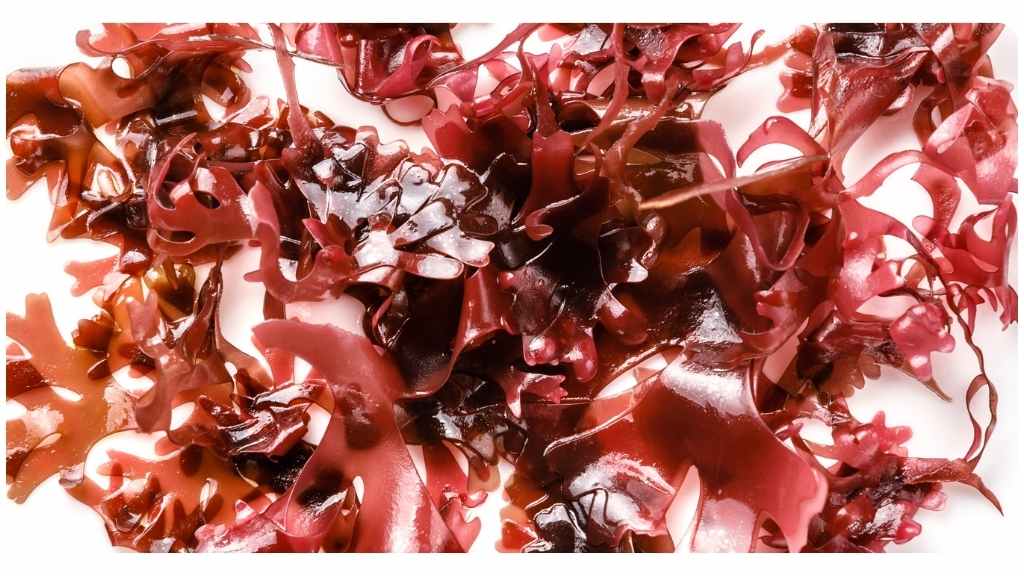
Table of Contents
What is Dulse?
Dulse, known scientifically as Palmaria palmata, is a type of red seaweed found on the northern coasts of the Atlantic and Pacific Oceans. It primarily grows in cold waters on rocky coasts, and can even be located as far north as the Arctic Circle.
Dulse is one of the more aesthetically pleasing seaweeds, with a deep crimson color.
Like other seaweeds, dulse is rich in numerous nutrients, including vitamins, minerals, and phytochemicals.
Specifically, dulse is known for its relatively high protein and amino acid content, as well as:
- Vitamin K
- Several B-vitamins (e.g. B1, B2, B3)
- Calcium
- Magnesium
- Potassium
- Iodine
- Polysaccharides
- Kainic acid
- Beta-carotene
Moreover, dulse, like all red seaweeds, is particularly high in flavonoids, phenolic acids, and other antioxidant compounds.
Last but not least, dulse contains a high amount of eicosapentaenoic acid (EPA), a type of omega-3 fatty acid; it also has a favorable omega-3 to omega-6 ratio (usually around 1:1).
Health Benefits of Dulse:
With its diverse and dense nutrient profile, it may come as little surprise that dulse benefits the body in a number of different ways. While research is still growing and likely to elucidate more health benefits down the road, dulse thus far appears to offer the following effects on human health:
1. Antioxidant Properties
It is likely that dulse benefits the body due to its high concentration of antioxidants, which are important for warding off many chronic diseases and improving overall health.
One of the earlier studies on dulse found that a polyphenol-rich dulse extract was able to offer significant free-radical scavenging activity, while also inhibiting lipid peroxidation. Dulse extract was also found to have antiproliferative effects.
Another study investigated dulse extract and found that eicosapentaenoic acid (EPA) was the most abundant fatty acid in dulse. EPA has significant antioxidant and free radical-inhibiting activity.
Another study found that a protein hydrolysate extract from Palmaria palmata contained 15 different antioxidant peptides.
These results are similar to another study on dulse extract, which found similar antioxidant properties. They concluded it could be useful in nutraceuticals and functional foods.
Summary:
Dulse appears to have antioxidant activities, although direct human studies are needed to confirm this finding.
2. Anti-Inflammatory Properties
Antioxidant and anti-inflammatory effects go hand in hand, so it’s no surprise that dulse may also reduce inflammation.
In a human cell study, a phenolic extract from dulse was able to decrease markers of inflammation, such as neutrophils, cytokines, and pro-oxidants. The researchers concluded that these decreases in inflammatory markers could make dulse a candidate for preventing some health disorders, including atherosclerosis.
Another study found that a water extract of dulse was able to decrease inflammatory markers in murine cells while helping to decrease overall inflammation. In this study, phycobiliproteins and chlorophyll seemed to be the compounds most responsible for these anti-inflammatory effects.
Surprisingly, a randomized parallel placebo-controlled clinical trial found that administering dulse-enriched bread actually increased C-reactive protein and other inflammatory markers. The authors noted that the changes were within clinical ranges and that the increase in some inflammation could provide potential immunostimulatory effects.
Based on this study alone, and the general lack of human research, more studies are needed.
Summary:
Several studies show that dulse may be helpful in inflammation reduction, however, based on the general lack of human research, more studies are needed.
3. Anti-Diabetic Properties
There also appear to be a few ways dulse benefits diabetes and overall metabolic health.
First, a randomized, double-blind placebo-controlled trial found that taking dulse capsules (2g/day) for 8 weeks led to decreased triglycerides in women, although there weren’t any significant improvements in glycemic control or other metabolic markers compared to controls.
Another study lo