

Cinnamon is a spice with a long history of use in traditional medicine. It’s touted as a natural remedy for a variety of ailments, including digestive problems, diabetes, and arthritis.
Modern research indicates that cinnamon may help with blood sugar regulation, heart health, gut health, and more.
In this article, we will look at the health benefits of cinnamon, its safety, and its history.

Table of Contents
What is Cinnamon?
Cinnamon is an evergreen tree in the Lauraceae (i.e. laurel) family of plants. It was originally native to southern China but is now widely cultivated throughout Southeast Asia (India, Indonesia, Laos, Malaysia, Thailand, and Vietnam).
The scientific name for the popular cinnamon varietal is Cinnamomum cassia (i.e. Chinese cinnamon). However, there are many other types of cinnamon that are widely available, including:
- Cinnamomum verum (Ceylon cinnamon)
- Cinnamomum loureiroi (Saigon cinnamon or Vietnamese cinnamon)
- Cinnamomum burmannii (Indonesian cinnamon)
- Cinnamomum citriodorum (Malabar cinnamon)
Most of these different types of cinnamon can be used interchangeably. However, it’s said that Ceylon cinnamon has the best flavor profile for baking foods or desserts.
Cinnamon is rich in various phytochemicals, including:
- Terpenoids
- Phenylpropanoids
- Glycosides
- and more
Traditional usage says that cinnamon is helpful for heart health, gastrointestinal complaints, gynecological disorders, and inflammation.
Modern studies have confirmed that cinnamon benefits human health in a variety of ways, including having antitumor, anti-inflammatory and analgesic, anti-diabetic, antimicrobial, cardiovascular protective, neuroprotective, and immune system boosting effects.
Health Benefits of Cinnamon
Below are the top research-backed health benefits of cinnamon.
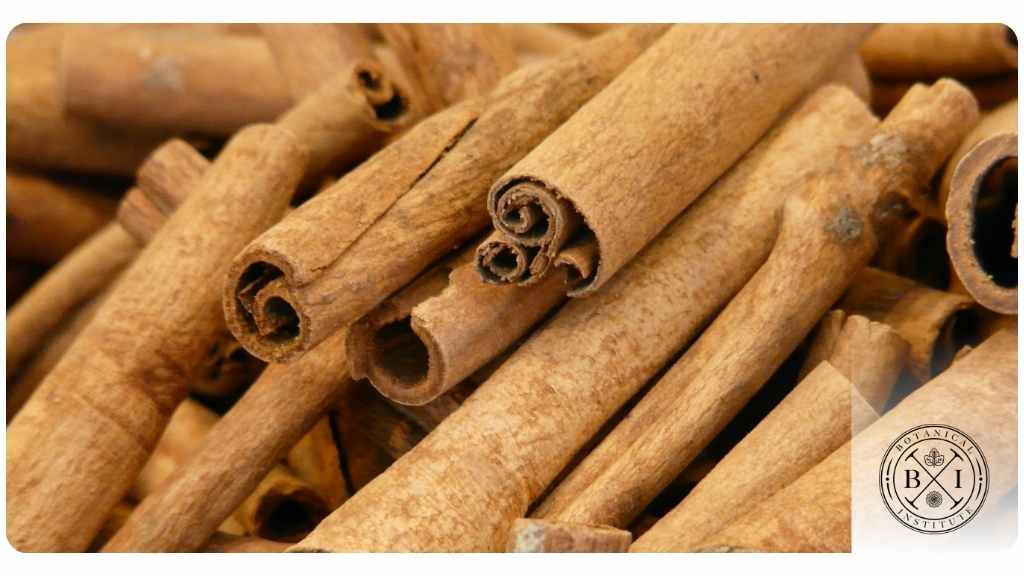
1. May Lower Blood Sugar
Research indicates that cinnamon benefits the body in its ability to help stabilize blood sugar levels. In fact, research shows that cinnamon is an important herb for hyperglycemia.
Elevated blood sugar levels, known as hyperglycemia, occur when there is too much sugar in the blood. This happens when your body has too little insulin, the hormone that transports glucose into the blood, or if your body can’t use insulin efficiently. The condition is most often linked with diabetes.
A triple-blind, placebo-controlled clinical trial in 140 individuals with type II diabetes found that cinnamon helps to lower blood glucose levels. The participants were given cinnamon bark powder or placebo in 500mg capsules twice daily for 3 months in the study. The group given cinnamon was found to have a reduction in body weight, blood sugar levels, as well as cholesterol numbers. The researchers noted that these benefits were found to be significantly more prominent in patients with higher baseline BMI (BMI ≥ 27).
Another randomized, placebo-controlled, triple-blind clinical trial looked at the effect of cinnamon on blood sugar levels. This study involved 160 individuals with diabetes who were given either a placebo or 3g of cinnamon daily. After 90 days, participants in the cinnamon group had statistically significant reductions in various blood sugar markers (including a 0.2% decrease in glycated hemoglobin and 0.55 mmol/L of fasting venous glucose). These reductions are modest but very promising.
A meta-analysis of the research on cinnamon and blood sugar found that it helps to improve glycemic levels in individuals with pre-diabetes, diabetes, and pre-treatment HbA1c.
A randomized, controlled trial found that cinnamon helped to reduce fasting plasma glucose and glucose tolerance in individuals with pre-diabetes over 12 weeks. The study participants were given either a placebo or 500mg of cinnamon three times daily.
Another meta-analysis found that studies that used 1.5g of cinnamon (or more) had robust blood sugar-lowering effects.
A placebo-controlled study looking at the effects of Cinnulin®, a unique water-soluble extract of Cinnamomum cassia, in pre-diabetic individuals. The study participants were randomly assigned to supplement their diet with either Cinnulin PF® (500 mg/d) or a placebo for 12 weeks. At the end of the study, the Cinnulin PF® group was found to have had significant decreases in fasting blood glucose (-8.4%), systolic blood pressure (-3.8%), and an increase in lean mass (+1.1%).
Summary:
Research indicates that cinnamon may help to improve various blood sugar markers.
2. May Support Heart Health
Research shows that cinnamon may ben